In this issue:
2 – MSA Student Spotlight
3 – Student Spotlight Nominations
4 – Henry Pavelek Sr. Memorial Scholarship
5 – Halloween Contest
6 – MSA SPS resources

In this issue:
2 – MSA Student Spotlight
3 – Student Spotlight Nominations
4 – Henry Pavelek Sr. Memorial Scholarship
5 – Halloween Contest
6 – MSA SPS resources




University of Wisconsin-Madison
Anne Pringle
I’m using genomics to explore the how the evolutionary development and cryptic diversity of Amanita muscaria and its closest relatives in section Amanita.
I had the excellent opportunity to attend an NSF funded workshop on the genomics of plant-fungal co-invasions in South Africa.
I’d like to pursue a postdoctoral position and continue my work on genus Amanita!
In my spare time I enjoy playing country tunes on my guitar and fishing in Madison’s lakes.
The first fact that got me interested in fungi is that they are more closely related to animals than plants. This blew my mind when I first found out. They are so much more complex than we have yet discovered. I love the fact that there are even fungi that parasitize algae too!

In this issue:
2 – New Board Announcement
2 – General Announcements
3 – MSA 2024 Annual Meeting Review
5 – MSA SPS Resources

In this issue:
2 – General Announcements
3 – 2024 SPS Digital Art Contest Winners
4 – 2024 Photo Contest Winners
5 – MSA-SPS Events on Annual Meeting
6 – Mycologists & Musings Speakers
7 – Tips for your first MSA meeting
8 – Student Spotlight: Alison Munaylla-Bohorquez
11 – MSA SPS Resources


Arlington, Virginia
Beltsville Agricultural Research Center (Beltsville, MD)
Dr. Megan Romberg in USDA APHIS National Identification Services
I’m currently working with the USDA in Agricultural Research Services through an internship program under the Hispanic Association of Colleges and Universities. Since January, I’ve been shadowing national identifiers in diagnosing plant samples intercepted at US borders as well as documenting specimens of the US National Fungus Collections using Mycoportal. I’ve also pursued a research investigation study on the potential synonymy between Uredo calotropidis and Uromyces asclepiadis, both heteroecious rust fungal pathogens found in Apocynaceae hosts. I even presented my work at the Mid-Atlantic States Mycology Conference held at Duke University!
This past September, I was awarded the Sequanota Foray Scholarship which allowed me to attend the annual Sequanota foray hosted by the Mycological Association of DC! I met a lot of wonderful people there, including my current internship advisor, Megan. I’ve also recently received an award from MSA’s photo contest for my image of a Pholiota terrestris, acceptance into the SPORES program which will allow me to attend this year’s MSA conference, and the Plants Grant award from the Botanical Society of America which will allow me to attend the Botany 2024 conference.
This summer I will be working at Mt. Rainier National Park as a biology assistant documenting sensitive plant species within the park. I’m very excited for this position through Environment for the Americas in collaboration with the National Park Service, and hope to bring some of my mycology knowledge to the botany work I’ll be doing!
Dr. Megan Romberg, who’s determination to keep learning new things impacts me everyday. I also look up to Dr. Bitty Roy and Heather Dawson, who were wonderful educators during my first internship, allowing me to ask questions and grow an interest in academia.
I’m a big fan of entomopathogenic fungi, I find their evolution and function to be both neat and terrifying. I’d like to see (or even carry out) more research on anamorphic entomopathogenic fungi beyond their application to biopesticides, like their distribution patterns and evolutionary characteristics. At Sequanota, we found an Akanthomyces and I was encapsulated by the idea that something could consume an entire organism in such an interesting and spiky way. Learning about entomopathogenic fungi such as Beauveria, Pandora, or Cordyceps, is such a treat, let alone the thrill of finding one. It always reminds me of how ruthless fungi can be.
Seeing Rye, the truffle hunting retriever, in action was definitely the highlight of my internship last summer. Watching him sniff around the forest and digging up truffles was so cute, and funny as Heather tried to keep him from eating the new-found treasure. That’s a good boy if I’ve ever seen one!
Photography tends to take up most of my time (certainly most of my bank account), especially during mushroom season. In August I bought a macro lens for my Canon Rebel T5 and I’ve been passionate about photography ever since. I enjoy using my Asahi Pentax film camera as well, which also has a macro lens that gives me cool macro-film shots! Outside of macro I like to use my Fujifilm XT-20 to capture moments of everyday life, which typically includes friends, family, and my environment.
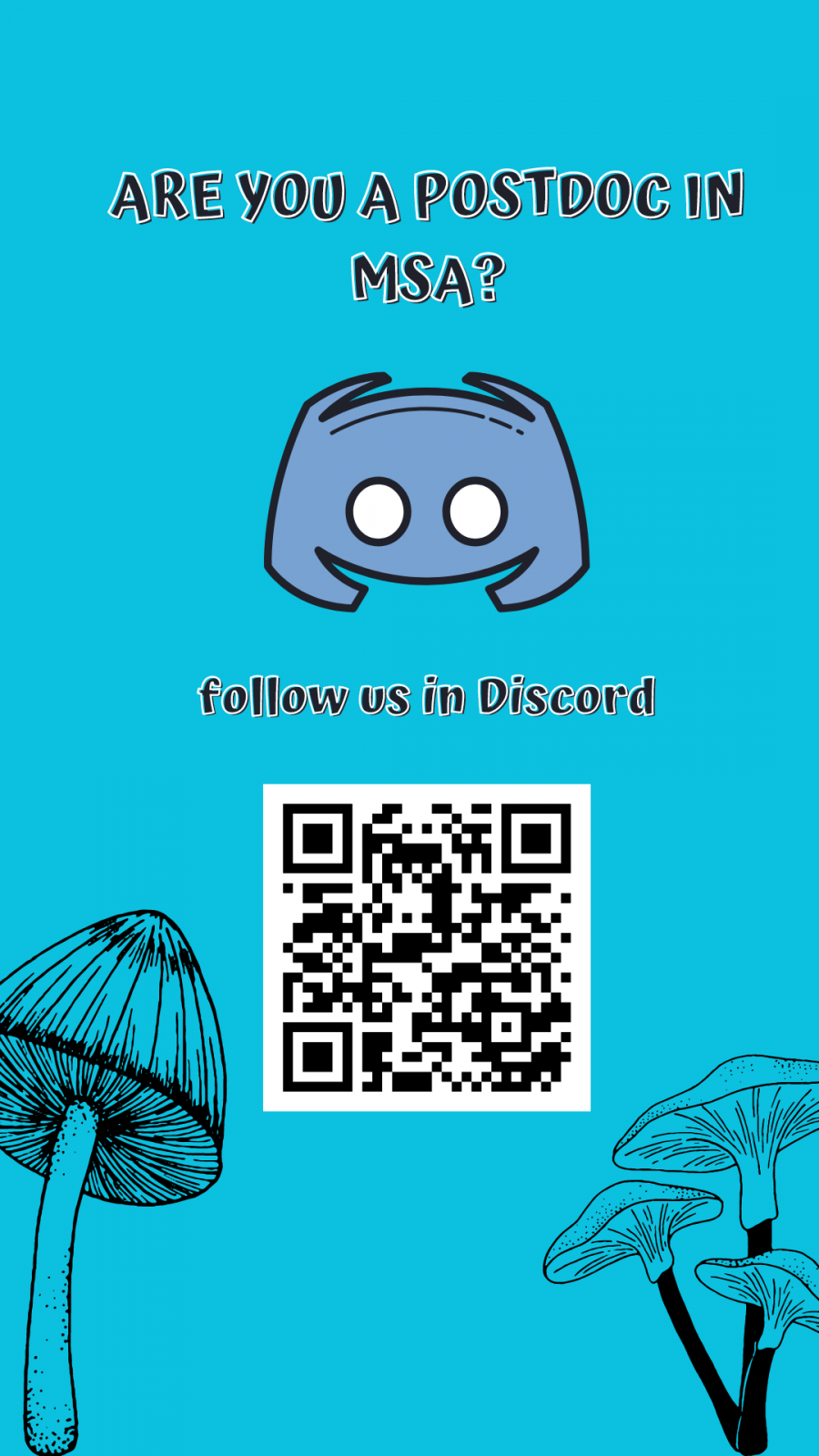
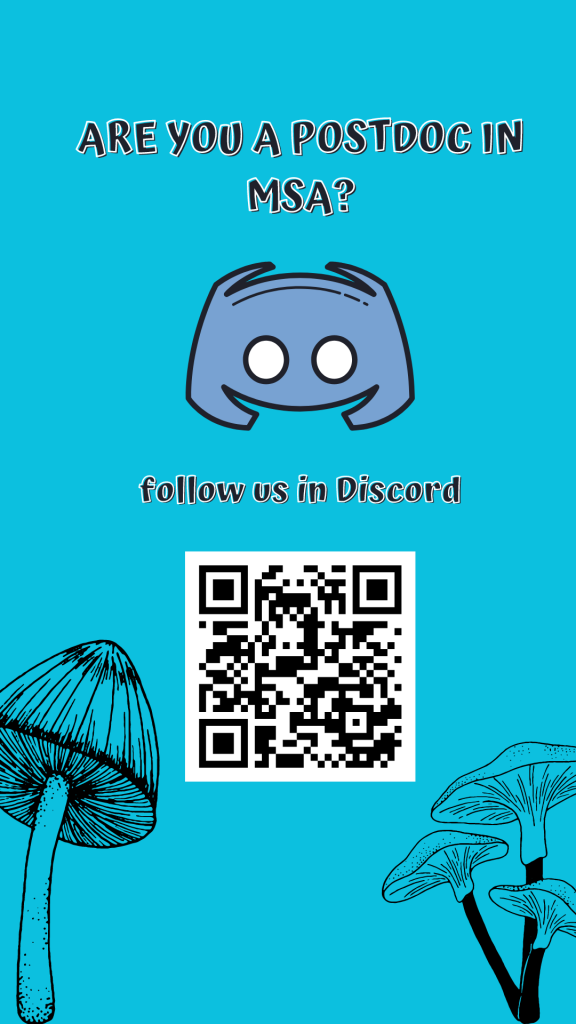
Are you a postdoc in the Mycological Society of America? Then, we’d love for you to join our MSA Postdocs Discord community! Follow the link below to join:
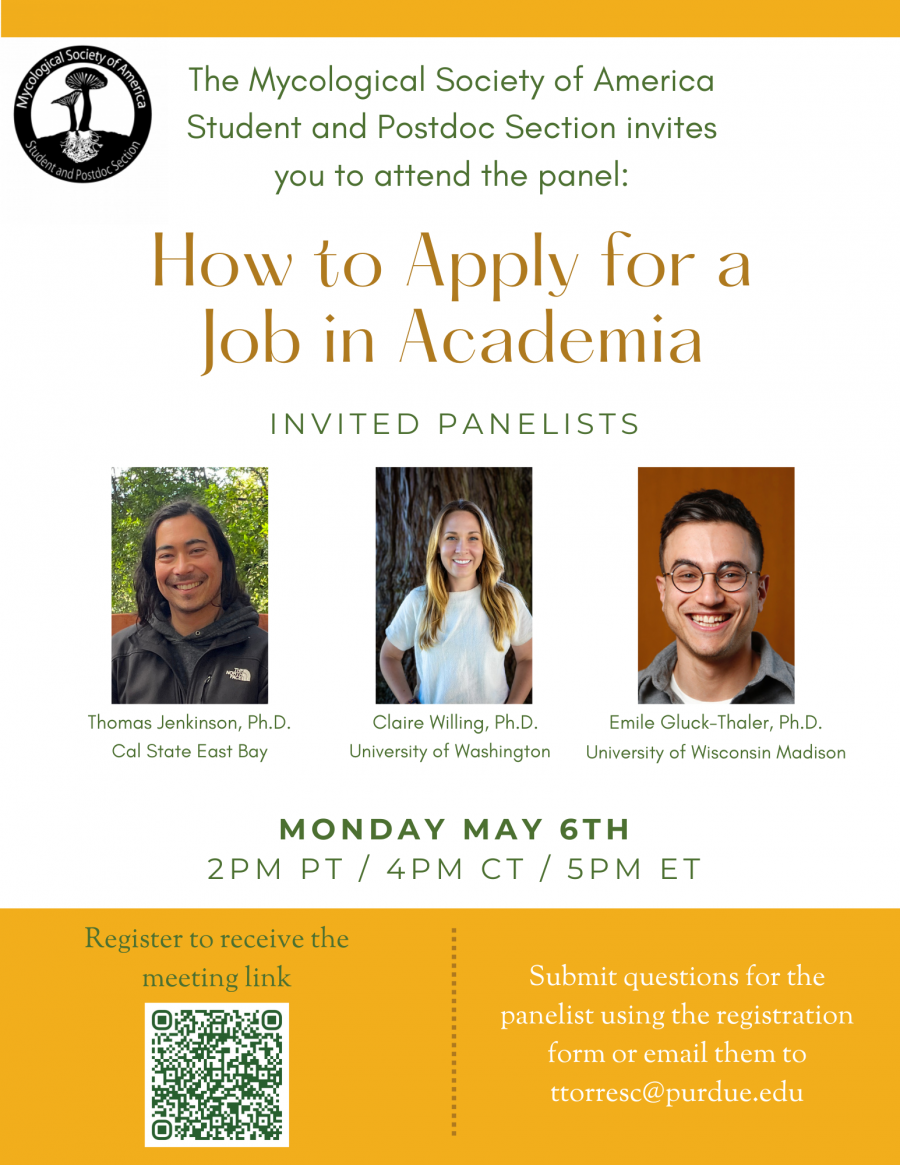
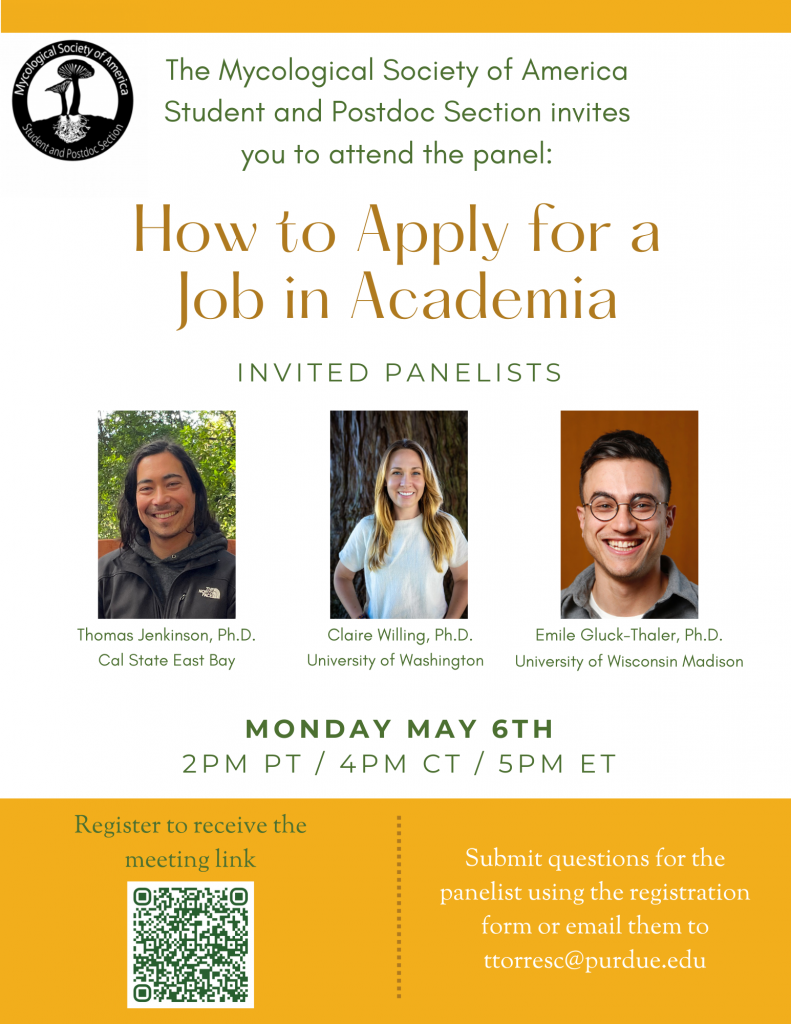
How do you apply for jobs in academia? Join our panel of early career academics on Monday, May 6 at 5 pm ET (2 pm PT) as they discuss their experiences with employment after completing their Ph.D.
This event has passed, but you can view the panel on our Youtube channel.
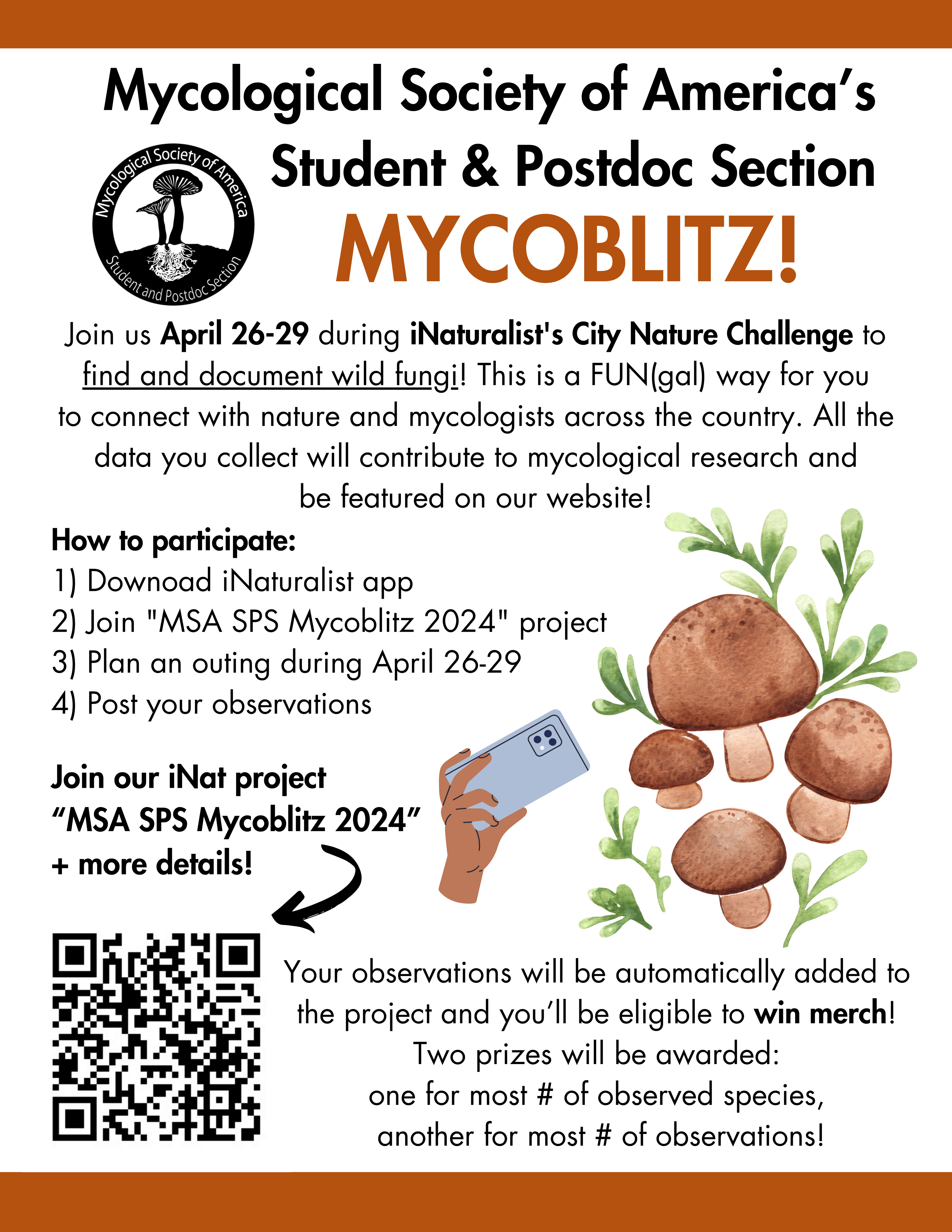
Join us April 26-29 during iNaturalist’s City Nature Challenge to find and document wild fungi! This is a fun(gal) and accessible way for you to connect with nature and mycologists across the country. Ultimately, all the data you collect will be pooled and usable for mycological research!
How to participate:
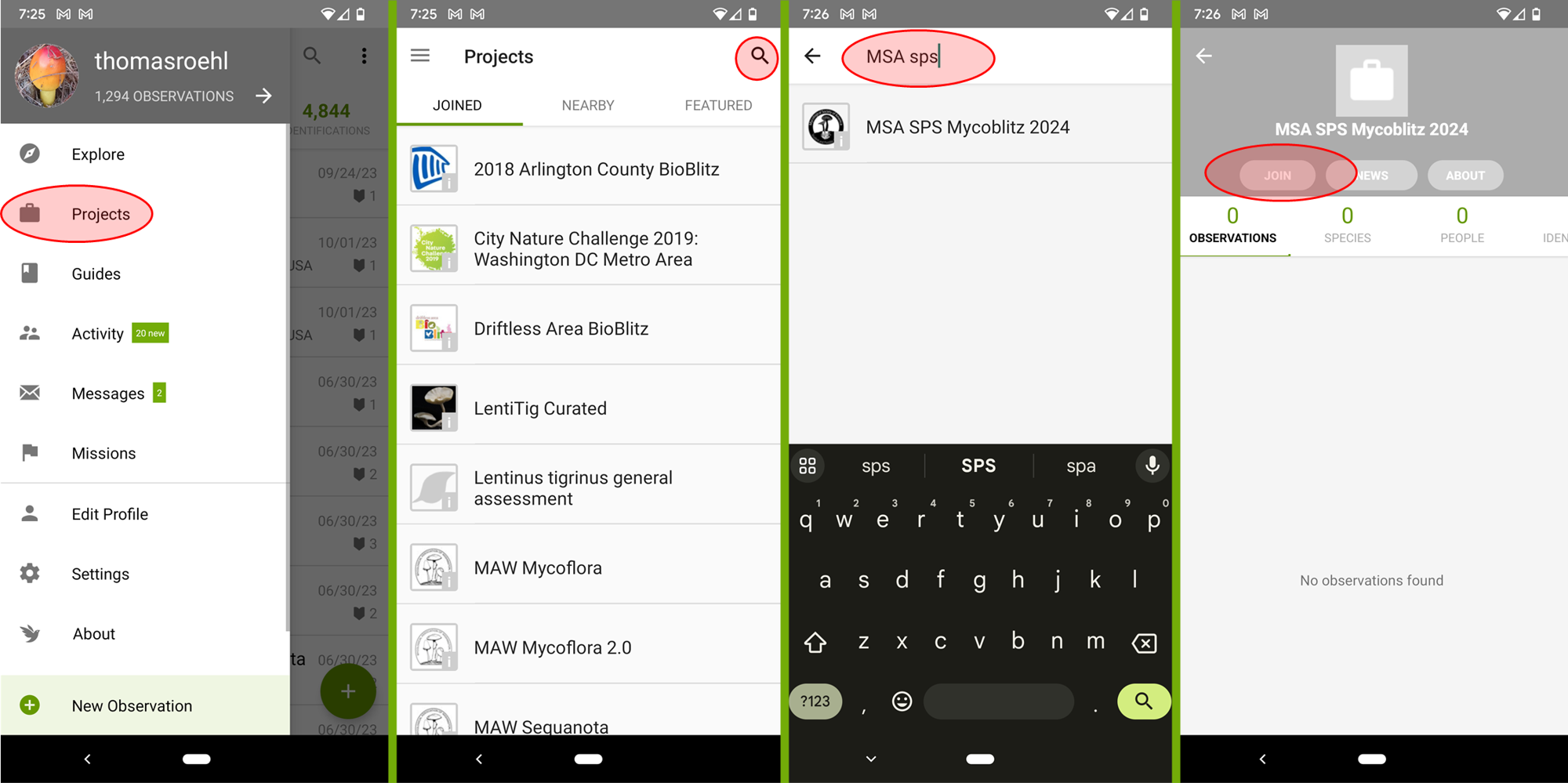
That’s all! Your observations will be automatically added to the project and you will be eligible to win one of these prizes of MSA swag:
Want more MSA merchandise? Check out our Bonfire store!
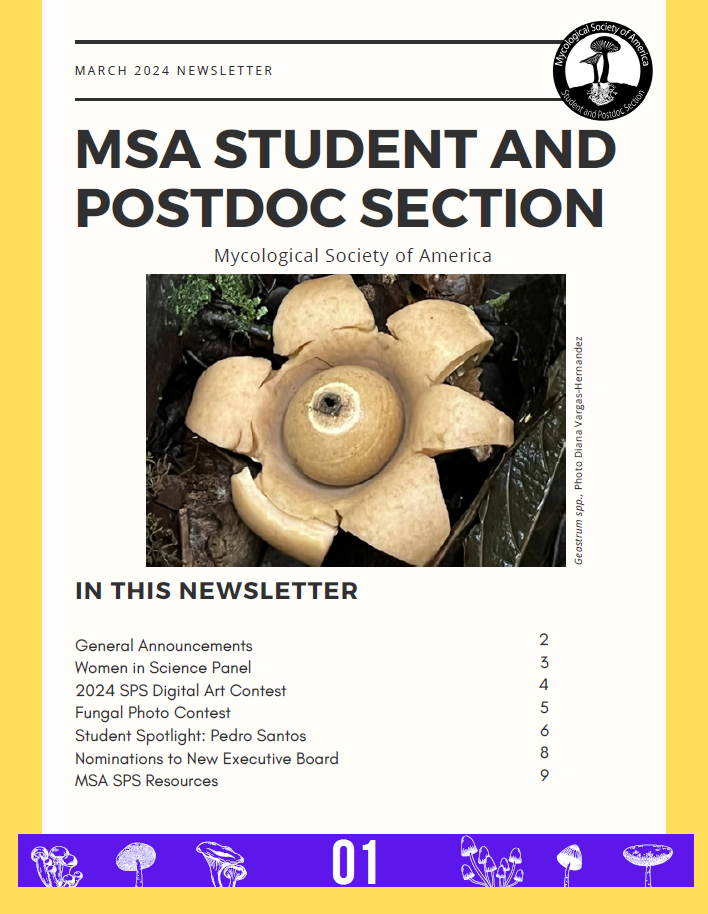
In this issue:
2 – General Announcements
3 – Women in Science Panel
4 – 2024 SPS Digital Art Contest
6 – Student Spotlight: Pedro Santos
8 – Executive Board Nominations
9 – MSA SPS Resources
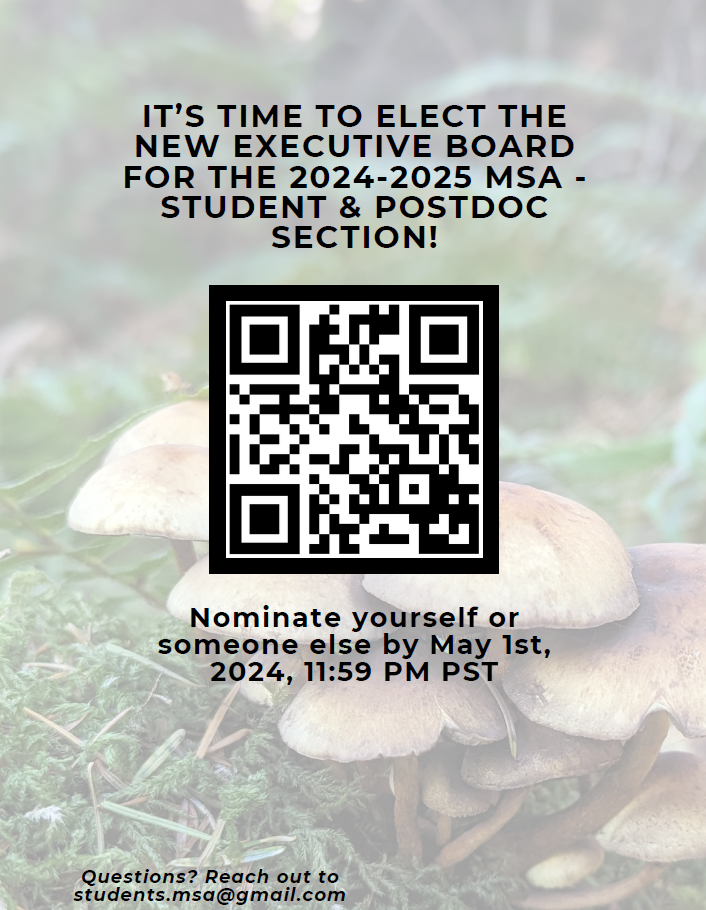
It’s time to elect the new MSA SPS Executive Board for the 2024-2025 academic year! Interested in helping us build a vibrant community of student and postdoc mycologists? Then, nominate yourself – or someone else! Nominations are due by May 1, 2024, 11:59 PM PST.
Powered by WordPress & Theme by Anders Norén